Évènements
14-15 Mai 2026

Évènement OpenMod Canada

La modélisation énergétique open source s’est intégrée aux processus réglementaires et de planification des systèmes dans un nombre croissant de juridictions. La communauté OPENMOD — l’un des réseaux de praticiens les plus actifs en planification énergétique — rassemble des chercheurs, des opérateurs de systèmes, des régulateurs et des développeurs qui collaborent ouvertement sur des modèles, des données et des méthodes.

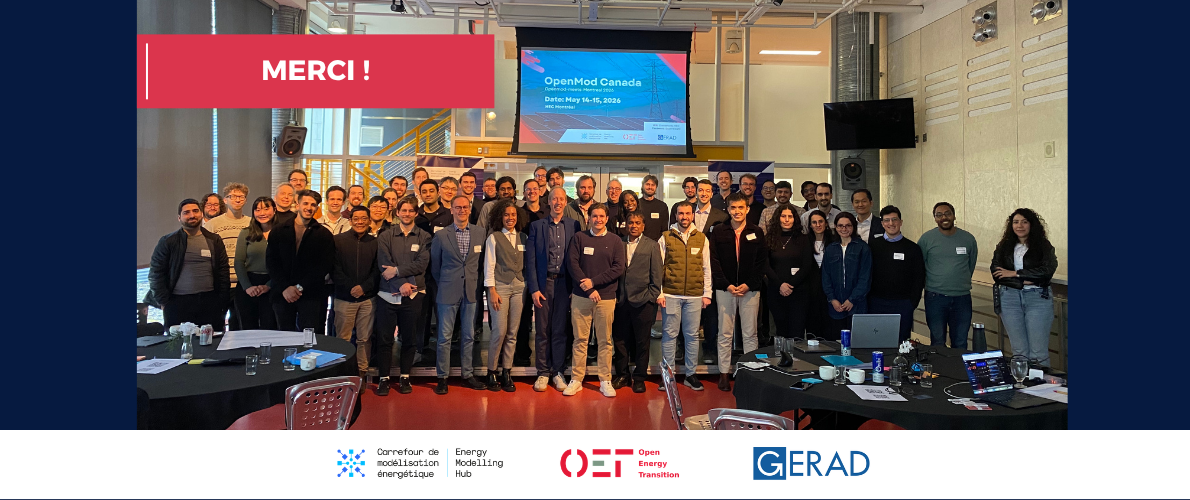
Ce mois de mai, le CME, le GERAD et Open Energy Transition co-organisent l’Atelier OPENMOD Canada 2026 à Montréal. L’événement s’inscrit dans la continuité de l’événement OPENMOD Meets USA 2023 à Stanford et mettra l’accent sur la modélisation ouverte comme standard pour la planification énergétique.

Détails de l’événement :

  • Quand : 14-15 mai 2026
  • Où : HEC Montréal (Montréal, QC) / En ligne (conférences éclair diffusées en direct)
  • Coût : Gratuit

Notez que la participation en personne à Montréal est encouragée pour favoriser les échanges techniques.

Évènement OpenMod Canada
14-15 Mai 2026|14-15 mai 2026 | HEC Montréal - Édifice Hélène-Desmarais |Montréal, Canada
Agenda
Jour
1
14 Mai 2026
8:30-15:35

Panel 1 : Modèles ouverts en matière de planification, de politique et d’institutions

Modérateur: Olivier Bahn

Luciana Marques — Rethinking Energy Planning: What Open-Source
Models Reveal About Network Development and Flexibility Needs

Samuel  Dotson

Simon Langlois-Bertrand

Edouard Clément — Introducing the Energy Policy Monitor (EPM)


Panel 2 : Méthodes, incertitude et modélisation responsable

Modérateur: Normand Mousseau

Davey Elder — Diagnostic Modelling: A Framework of Principles for Responsible Energy Systems Modelling

Dheepak  Krishnamurthy — Assessing the Spatiotemporal Generalizability of Power Outage Prediction Models using GeoAI Foundation Models

Samuel  Dotson

Kamyar  Amirmoeini — Integrated assessment of the nexus among energy transitions, climate impacts, and adaptation responses


Discussions éclair

Matthieu Souttre: Coupling energy system models with life-cycle  assessment — a case study on Québec

Yamil Essus — Assessing the Spatiotemporal Generalizability of  Power Outage Prediction Models using GeoAI

Madanmohan Ghosh — Beyond the numbers: Examining economic  modeling tools for climate change policy analysis

Tengxiang Ren — Bridging the gap between long-term planning  and grid physics: coupling capacity expansion  with PowSyBl Metrix

Lih Wei Yeow — Energy system implications of decarbonized  truck electricity demand profiles

Manish Mosalpuri — Analyzing Industrial Decarbonization Pathways  in Canada using CANOE

Florian Mitjana — Impacts of various energy efficiency options on  the power system in Québec

Soroosh Sabaei — Cross-Border Renewable Integration: The Role  of Québec Hydropower in the Decarbonization of  New York City

Sara Ghaboulian Zare — Hydrogen Pathways for Metropolitan Energy  Transition — Montréal Metropolitan Community

Maïka Lamoureux — Regionalizing Canada in AD-MERGE:  Implications for Net-Zero Pathways and  Climate Policy

Michel Denault — On the Value of Saved Power


Séance plénière

David Diaz — Open modelling feature gaps and priorities


Démonstration technique

Nathan de Matos, Michel  Bui, Adrien Prigent — PyPSA-Canada framework and national model


Vous pouvez consulter le programme complet ici.

Jour
2
15 Mai 2026

Discussions éclair

Daniele Lerede — Assessing Electrofuels Supply Potential in the United States using PyPSA-Earth 

Davey Elder — Modeling Multisectoral Interactions in the Temoa Canadian Open Energy Model

Andrew Vigars — Geospatial Optimization of Power-to-X Fuels and CCUS Supply Chains for Canadian Net-Zero Pathways 

Xiao Li — The role of energy carriers in cross-sector decarbonization: insights from CAN-TIMES

Erica Attard — Generative city-based optimization model for energy technologies (COMET)

Davey Elder — Assessing the System Value of Emerging Technologies in A Multi-Sector Energy Model

Séance en petits groupes

Francis Lebreux Desilets — Industry Data and Modelling Opportunities

Vous pouvez consulter le programme complet ici.